


- Monday, 26.10.26, 11:00 - 12:00 Uhr
Why you should use the best of both worlds when introducing digital business – Ambidexterity as a management concept for the digital age

Do you know Steve Sasson? He is recognized as the inventor of the first digital camera. In 1974, as a young engineer, he built this device for his employer Eastman Kodak, which turned the photographic industry upside down as a groundbreaking technological change. But Kodak swept this innovation under the carpet. Certainly one of the most fatal mistakes of recent business history. Kodak had to file for insolvency in 2012. The Kodak Moment became the epitome of failure for successful companies that miss out on disruptive trends. But why do these companies fail at the end of the day? After all, they supposedly have everything they need for ongoing success: financial strength, loyal customers, brand strength and intelligent minds like Steve Sasson.
What these manufacturing companies do can be summarized under the term exploitation of a business segment. They increased the performance of their existing products and continued to optimize the processes for production and distribution. However, they have failed because other companies have dared to invest in new groundbreaking technologies and thus turn entire industries upside down.
Now one might think that in order to be successful, a manufacturing company should focus exclusively on the development of new business areas, also known as exploration. Start-ups are the ultimate embodiment of the exploration of new business areas. Failory regularly publishes statistics of failed start-ups by industry. Especially in industries with a focus on digital transformation of manufacturing companies, there is a very high rate of failed start-ups.
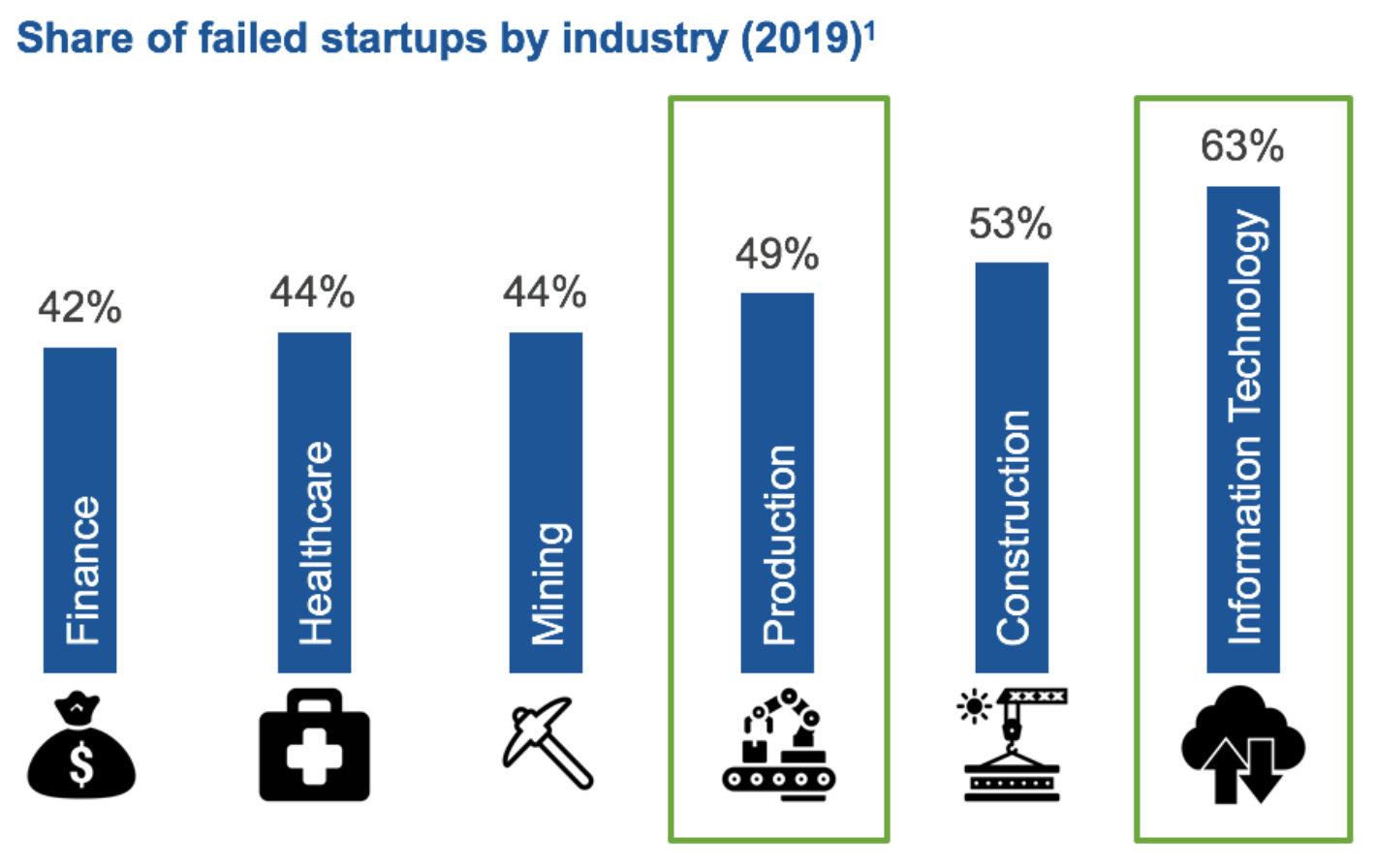
Failory (2020) The Ultimate Startup Failure Rate Report
The failure of start-ups is mainly due to:
- lack of domain knowledge: they develop without taking into account the needs of the market
- lack of customers: they have no supportive pilot customers to test their idea
- wrong planning: they miscalculate time and financial planning
Looking back on the Kodak example, it is clear that exploitative companies have their strengths precisely in the weaknesses of explorative ventures. But they go too far. They are too focused on optimizing a domain and thus miss trends. By focusing on the existing customer base, they do not get new impulses. Rigid, long-term plans show too little flexibility for new market developments. Both exclusive exploitation of existing business and pure exploration therefore do not lead to long-term success within the manufacturing industry.
This is precisely where a management concept comes into play that has gained increasing attention in recent years – ambidexterity. This term, which describes the two-handedness of a person in medicine, is increasingly being seen in the context of new digital business models as a necessary capability of a company. Ambidexterity describes the ability of a company to simultaneously explore new business areas and exploit existing ones. To be a Kodak and a startup at the same time.
Ambidexterity is the combination of the best of both worlds – the exploitation of the core business and the exploration of new business areas
The advantages are obvious, by combining the best of both worlds. The company’s refined and proven capabilities in its existing core business are used to efficiently exploit assets and business areas. The generated money and assets (data, machines, experts and customers) are used to explore new business areas. This enables the company to adapt to changes in the market and arising new technologies. This leads to long-term success.
But why does ambidexterity gain more relevance, especially when introducing digital business models, like remote service or other data-driven services? After all, companies have survived in the past if they successively adapted to changing market conditions. The reason for this can be found when comparing the adaptation rate of technologies in the past.
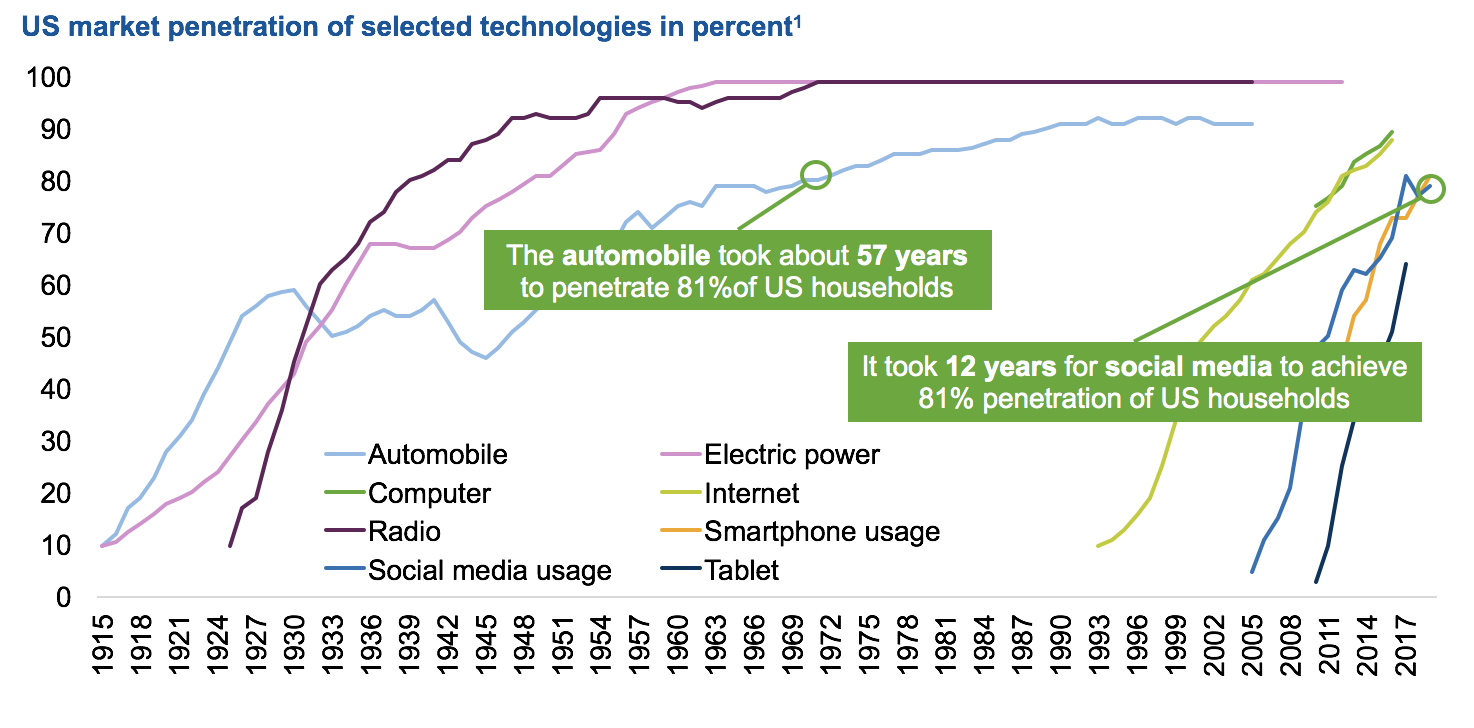
Our World in Data (2020) US market penetration of selected technologies
This comparison can be found in the example of US households at Our World in Data, among others. It shows that it took the automobile 57 years to reach 81% of US households. Social media, as a digital technology, only needed 12 years. Digital technologies, on which digital business models are based, penetrate the market at a much higher speed and have shorter innovation cycles. An incremental adaptation of business models by a manufacturing company is therefore no longer successful. In this environment, a strategic competitive advantage is the ability to achieve a parallelism of exploration and exploitation, i.e. to engage in ambidexterity.
Some companies already try to leverage ambidexterity in their innovation process. Airbus integrated an exploratory unit, Airbus Digital Ventures, into its organization, which systematically develops and markets digital business models in cooperation with the core organization. An essential component of Airbus Digital Ventures’ approach is the integration of its core business into exploration. In this way, commitment is created from the core organization by identifying the needs of the existing units for new business areas. Additionally, the skills and assets of the core organization are shared with Digital Ventures as part of cocreation. Simultaneously, knowledge exchange is formalized within the framework with Digital Ventures taking over an advisory role.
An example of one of their innovations is Airbus Aerial, which is a cloud-based platform for aerial images. Airbus collects existing data, e.g. satellite and commercial drone images. This data is processed by AI algorithms and provide top down aerial views of assets, resources and situations for agricultural companies, insurers, state and local governments.
It is clear that ambidexterity is certainly not a state that can be achieved easily in a short period of time through the creation of digital units or hubs. Instead, a successful combination of the best of both worlds requires unremitting efforts to keep reinventing strategy, organization, IT systems, resources and culture.
But in times of digitalization, it is imperative for companies to balance both the exploitation of the established core business and the exploration of new technologies to ensure success in the long run.
If you want to dive deeper into the topic with best practices and industry insights, you can download our whitepaper here.
About the author:
Dr. Felix Optehostert is Senior Manager Venturing Services at the Industrie 4.0 Maturity Center. He supports companies in leveraging start-up cooperation for their digital transformation journey and conducts Industrie 4.0 Maturity assessments and roadmap developments. Together with his team he brings in deep expertise in data-driven business development and digital transformation. You may contact him by e-mail at felix.optehostert@i40mc.de.
Das könnte dich auch interessieren
Community
Premiere im Medienhafen: Erste AI Week Düsseldorf setzt auf KI-Praxis zum Mitmachen
Expert Talks, Praxissessions und Abendprogramm: Vom 23. bis 27. November 2026 findet im STARTPLATZ Düsseldorf erstmals die AI Week Düsseldorf statt. Fast 30 Sessions …
Community
Die richtige Domain fürs Startup: Namenswahl, Endungen und rechtliche Stolperfallen
Vor dem Kauf der Startup-Domain stehen Namensprüfung und Registerrecherche. Welche Endung passt, wo Markenrecht Grenzen setzt und wem die Domain gehört.
Community
Köln wird Teil der ELIAS Alliance: neuer KI-Standort Jülich-Aachen-Köln mit STARTPLATZ
Europas Netzwerk für KI-Forschung und Gründen wächst um acht Standorte. Einer davon ist der ELIAS Node Jülich-Aachen-Köln, und STARTPLATZ ist als Partner dabei.
Kommende Events
- Tuesday, 27.10.26, 09:00 - 18:00 Uhr
- STARTPLATZ Köln, Im Mediapark 5, 50670 Köln
- Tuesday, 27.10.26, 12:30 - 13:15 Uhr
- STARTPLATZ Düsseldorf, Speditionstraße 15a, 40221 Düsseldorf
- Jakow Smirin & Lorenz Gräf
Newsletter
Neue Beiträge und Termine per Mail
Einmal im Monat: was im STARTPLATZ passiert, welche Events kommen, was Gründer:innen gerade bewegt.
Newsletter abonnieren → EventsPersönlich weiterreden
AI Friday, Meetups, Masterclasses, Rheinland Pitch — die Themen des Blogs live in Köln und Düsseldorf.
Alle Events → MitschreibenGastbeitrag veröffentlichen
Du hast Praxiswissen für Gründer:innen? Schick uns deinen Vorschlag — wir prüfen jeden Beitrag redaktionell.
Gastbeitrag anfragen →